

About Course:
PT101 Practical Python for Finance & Trading Masterclass
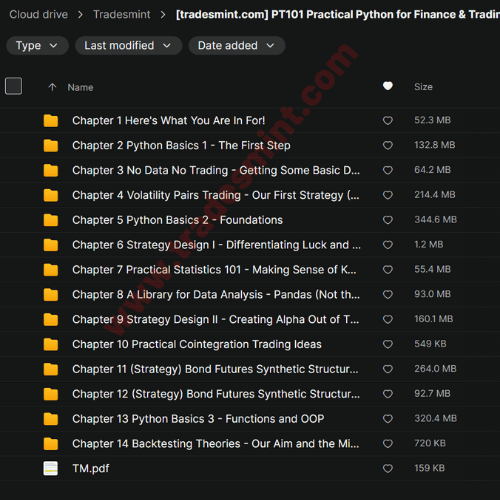
Chapter 1 > Here’s What You Are In For!
- Start AT101 or PT101?
- Start Why Code for Trading? The New Mindset – Trading Ideas and Concepts (Part 1)
- Start Why Code for Trading? The New Mindset – Trading Ideas and Concepts (Part 2)
- Start Why Code for Trading? The New Mindset – Trading Ideas and Concepts (Part 3)
- Start The Real Holy Grail of Trading
- Start The First Step – How To Start Your Journey?
- Start Simple vs Complex – Overview and Approach to Strategies in this Course
- Start Teaser Strategy: 1+3-3+1 Bond Futures Calendar Spread
Chapter 2 > Python Basics 1 – The First Step
- Start Why Python over other Programming Languages
- Start AlgoTrading101 Partners with Holistic Coding and Algo-Hunter
- Start Get the Snake – Installing Anaconda
- Start Using the Command Line
- Start Overview of our Research and Execution Tool – Jupyter Notebook
- Start What Snakes are these? Anaconda vs Python
- Start Fastest Way to Open Your Jupyter Notebook
- Start Download Code for Chapter 2
- Start The Basic Building Blocks – Variables and Expressions
- Start Know what You Can Do – Jupyter Notebook & Python Superpower List
- Start Copy Others’ Code – Python Libraries and Packages
Chapter 3 > No Data No Trading – Getting Some Basic Data In
- Start Download Code for Chapter 3
- Start Get Data from Quandl – Let’s Get Apple’s Stock Prices
- Start Quandl WIKI Database Limitations – Yahoo Finance to the Rescue
- Start Installing Library for Yahoo Finance API
- Start Retrieving Data from Yahoo Finance API – Just a One-Liner
Chapter 4 > Volatility Pairs Trading – Our First Strategy (A Teaser into Practical Pair Trading)
- Start 2 Behaviours – Correlation vs Cointegration
- Start Pair Trading – The Basic Cointegration Strategy (Part 1)
- Start Pair Trading – The Basic Cointegration Strategy (Part 2)
- Start Volatility Pairs Trading – Our Teaser Strategy (Intro)
- Start Volatility Pairs Trading – Check it with our Eyes! (Visual Backtesting) – Part 1
- Start Volatility Pairs Trading – Check it with our Eyes! (Visual Backtesting) – Part 2
- Start Longing, Shorting and Spreads
- Start Download Code for Chapter 4
- Start Volatility Pairs Trading – Preparing for the Statistical Backtest
- Start Volatility Pairs Trading – The Real Test! Running our Statistical Backtest (Part 1)
- Start Volatility Pairs Trading – The Real Test! Running our Statistical Backtest (Part 2)
- Start Volatility Pairs Trading – The Real Test! Running our Statistical Backtest (Part 3)
- Start Volatility Pairs Trading – The Real Test! Running our Statistical Backtest (Part 4)
- Start Volatility Pairs Trading – 10 Ideas to Level Up. Adapting to the Real-World
Chapter 5 > Python Basics 2 – Foundations
- Start Just so you don’t feel lost
- Start Running all Cells
- Start Download Code for Chapter 5
- Start Counting stuff in Python
- Start Variables contain different Types of Info – Data Types
- Start The Simplest Table (Lists of Values) + Datetime Management
- Start The Simplest Tables with Unchangeable Values – Tuples
- Start If A happens, do B – Conditional Statements
- Start Printing stuff – Formatting your texts and numbers
- Start Meaning behind String Symbols
- Start Do Something Many Times Using Code – For Loops
- Start Loops Practice 1 – Basic For Loops
- Start Do Something Many Times in a Different Way – While Loops
- Start Loops Practice 2 – Basic While Loops
- Start Looping Twice – Nested Loops
- Start Loops Practice 3 – Nested Loops
- Start If A then B, Many Times – Loops with Conditionals
- Start Loops Practice 4 – Conditional + Nested Loops
- Start Answers to Loops Practice 1 to 4
- Start Loops with some Control (Continue, Break and Pass)
- Start Loops Practice 5 – Calculating Stock Metrics
- Start Answers to Loops Practice 5
- Start For Loops without the Range Method
- Start When to use For vs While Loops
- Start Get Data from CSV and TXT
- Start Exporting dataframe to CSV
- Start Stuck at Programming? Self-Learning and Getting Help Guide
- Start Elegant Code vs Learning Trading
Chapter 6 > Strategy Design I – Differentiating Luck and Skill
- Start The Most Important Concept – Market Prudence
- Start Market Inefficiency Discovery vs Exploitation
- Start David vs Goliath – Can we outwit the Big Funds?
- Start Us vs Hedge Funds: Why We Dislike Trading on Lower Timeframes
- Start Outwitting the Masses – Second-Order Thinking
- Start How to Choose What Markets/Strategies to Trade
- Start Does this course suck? Or is it adding value to you?
Chapter 7 > Practical Statistics 101 – Making Sense of Key Figures
- Start Calculating Long Term Expected Payout of a Robot
- Start Statistical Significance and Law of Large Numbers – More is better
- Start What is an Abnormal Move – Understanding Standard Deviations
- Start Stock Returns Behaviour – Understanding Normal Distributions
- Start Minimum Sample Size and Application to Trading
- Start Cointegration Simplified
- Start Optional Readings on Statistics
- Start What are Correlation and Sensitivity/Regression
- Start The Real Role of Statistics in our Trading
Chapter 8 > A Library for Data Analysis – Pandas (Not the lazy animal!)
- Start Generating Random Numbers
- Start What is Pandas and Why Do We Need It?
- Start Download Code for Chapter 8
- Start Two Column Tables of Data – Dataframe (This one is important)
- Start Managing Dataframes – Editing our Tables
- Start Managing Dataframes 2 – Changing the Shape of our Dataframes
- Start Datetime Management – Adding Dates to Dataframes
- Start Pandas Exercise 1 – All You Need for Managing Dataframes
- Start Changing Dataframe’s Data Type
- Start Not-a-Number? Dealing with NaN and NaT
- Start Pandas Exercise 2 – Managing Non Numbers in your Data
- Start What is a Pandas Series?
Chapter 9 > Strategy Design II – Creating Alpha Out of Thin Air: The Magic of Synthetic Assets
- Start Introduction to Synthetic Assets – Why Does It Produce Alpha
- Start Types of Synthetic Assets – Hedging in Different Ways (Part 1)
- Start Types of Synthetic Assets – Hedging in Different Ways (Part 2)
- Start Moving Beyond Spreads – Spread^2 and Others
- Start Download Code for the Chapter
- Start Practice 1 (Questions) – Dollar-Hedged Structure
- Start Practice 1 (Answers) – Dollar-Hedged Structure (Part 1)
- Start Practice 1 (Answers) – Dollar-Hedged Structure (Part 2)
- Start Manipulating the Shapes of Structures using Multipliers
- Start Effect of Multipliers – Summary
- Start An Impossible Structure – One Ranging and One Trending
- Start Normalising the first value to 1
- Start Market-Hedging and Other Hedges
Chapter 10 > Practical Cointegration Trading Ideas
- Start 3 Cointegration Trading Ideas that we can Implement
- Start No-Code Trading Research Tools – Do Quick Research before Committing
Chapter 11 (Strategy) > Bond Futures Synthetic Structures – The Calendar Spreads I
- Start Bond Futures Calendar Spreads (Part 1) – One of the Most Stable Synthetic Asset – Introduction
- Start Bond Yields and Prices – They are Inverse!
- Start Bond Futures Calendar Spreads (Part 2) – Understanding the Fundamental Idea
- Start Finding Alpha in STIR Futures
- Start Download code for this chapter
- Start Code to download BAX data + 2 Coding tasks for you
- Start Downloading and Cleaning BAX Data
- Start Calculating and Plotting a Double Butterfly in Python (Part 1)
- Start Calculating and Plotting a Double Butterfly in Python (Part 2)
- Start The Easy Way – Charting STIR Futures Structures on Tradingview
- Start List of STIR Futures – Common and Less Common STIRs
- Start Opening a Interactive Brokers Demo account to Trade STIR Futures
- Start Using Interactive Brokers’ Booktrader (aka price ladder)
- Start Bond Futures Calendar Spreads (Part 3) – The Essence of the Strategy: Execution
- Start Bond Futures Calendar Spreads (Part 4) – The Source of Alpha: Level Up Your Execution
- Start Prepare for Battle – Set up your Interactive Brokers Layout (Part 1)
- Start Prepare for Battle – Set up your Interactive Brokers Layout (Part 2)
- Start Finding Your Asset in Interactive Brokers
- Start Mental Sums – Calculating Price of Double Butterfly from Booktraders
- Start Time for Battle! Demonstrating How to Execute a D.Butterfly (Part 1)
- Start Time for Battle! Demonstrating How to Execute a D.Butterfly (Part 2)
Chapter 12 (Strategy) > Bond Futures Synthetic Structures – The Calendar Spreads II
- Start New Weapon – Combination Order
- Start Demonstrating the new weapon – The Combination Order
- Start Understanding the Combination Order
- Start Bond Futures Calendar Spreads (Part 5) – Multi-Quarter Structures and Structures Equivalence
- Start A New Weapon – Finding Opportunities in the Term Structure (Part 1)
- Start A New Weapon – Finding Opportunities in the Term Structure (Part 2)
- Start Term Structure and STIR Pricing
- Start Bond Futures Calendar Spreads (Part 6) – Trading with the Drift
- Start Bond Futures Calendar Spreads (Part 7) – Strategy Difficulties and Risks
- Start Downloading and Storing BAX data in Bulk
- Start How much $ do you need for this strategy – Capital Requirements
- Start Bond Futures Calendar Spreads (Part 8) – Backtesting and other Considerations
- Start STIR Trade Sizing and Non-Entry/Exit System
- Start BAX End Note
Chapter 13 > Python Basics 3 – Functions and OOP
- Start Those who are good at Python can skip this chapter
- Start What are Functions – Our Little Factories
- Start Download Code
- Start User-Defined Functions – Learn to Code Your Own Factories!
- Start Functions Practice 1 – Questions
- Start Functions Practice 1 – Solutions (Part 1)
- Start Functions Practice 1 – Solutions (Part 2)
- Start What are Scripts – Simple Python file (Also: How to import your own code)
- Start Uses of Python Scripts vs Jupyter Notebooks
- Start Modules vs Libraries vs Packages – Understanding the Terminologies
- Start OOP Series – Object-Oriented Programming (OOP) Simplified. Objects store values and/or does stuff
- Start OOP Series – Difference between Classes and Objects
- Start OOP Series – Why do we need to learn OOP? Ans: We have no choice
- Start OOP Series – Object Variables: Storing Values (Part 1)
- Start OOP Series – Object Variables: Storing Values (Part 2)
- Start OOP Series – Object Functions: Doing stuff
- Start Objects Practice 1 – Object Variables (Questions + Solutions)
- Start Objects Practice 2 – Object Functions (Questions)
- Start Objects Practice 2 – Object Functions (Solutions) Part 1
- Start Objects Practice 2 – Object Functions (Solutions) Part 2
- Start Naming Conventions – How to name your classes, variables etc
Chapter 14 > Backtesting Theories – Our Aim and the Mistakes to Avoid
- Start What is Backtesting – Simplified
- Start The Aim of Backtesting – We are NOT trying to build the Ultimate Strategy
- Start 3 Big Mistakes of Backtesting – 1) Overfitting 2) Look-Ahead Bias 3) P-Hacking
- Start Solution to the 3 Big Mistakes in Backtesting


Reviews
There are no reviews yet.