

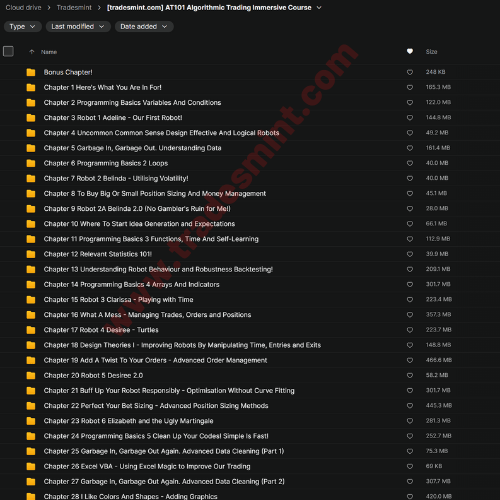



About Course:
AT101 Algorithmic Trading Immersive Course
Chapter 1 > Here’s What You Are in for!
- AT101 is Revamped!
- What are Trading Robots? (And why should I build them?) (Part 1)
- What are Trading Robots? (And why should I build them?) (Part 2)
- The First Step – How to Start Your Journey?
- MT4 Installer Direct Download
- MT4 for Mac
- Downloading Our Software (MT4)
- Introduction to MT4
- MT4 Basic Guide
- Download Template
- Structure of a Trading Robot (Part 1)
- Structure of a Trading Robot (Part 2)
- Structure of a Trading Robot (Part 3)
- Why choose MT4 over other software?
- Our Holy Grail – Secret to Successful Trading Robots
Chapter 2 > Programming Basics: Variables and Conditions
- The 3 Types of Code
- Syntax – The ABCs of Coding (Part 1)
- Syntax – The ABCs of Coding (Part 2)
- Reserved Words – Words you cannot use!
- Variables – The basic building blocks!
- Download Code for Expressions
- Expressions and Operations (Plus, Minus, Multiplication and Division)
- Operations and Precedence – Who comes first
- Conditional – If this then that (Part 1)
- Conditional – If this then that (Part 2)
- Chapter 2 Summary
Chapter 3 > Robot 1: Adeline – Our First Robot!
- Background to our Asset Class
- Chart Reading 101
- Download Codes for Adeline
- Theory behind Robot Adeline
- Coding Adeline (Part 1)
- Coding Adeline (Part 2)
- Understanding Shift
- Dry Run! – Our Robot Testing System (Part 1)
- Dry Run! – Our Robot Testing System (Part 2)
- 3 Types of Testing Method (Simple)
- Chapter 3 Summary
- Don’t worry about not understanding the code!
Chapter 4 > Uncommon Common Sense: Design Effective and Logical Robots
- Trading Robot Development Guide – Everything You Need to Succeed (Part 1)
- Trading Robot Development Guide – Everything You Need to Succeed (Part 2)
- Trading Robot Development Guide – Everything You Need to Succeed (Part 3)
- Pros and Cons of Trading Robots – Nothing is Perfect
- Calculating Long Term Expected Payout of a Robot
- Useful Resources
- Chapter 4 Summary
- Let’s Make the Course More Awesome
- Start Coding Your Own Trading Strategies
- Moving to Python?
Chapter 5 > Garbage In, Garbage Out. Understanding Data
- Data Sources and Storage
- Data Management
- Download Dirty Data
- Cleaning Data (Part 1)
- Cleaning Data (Part 2)
- Cleaning Data (Part 3)
- Trading on Bad Ticks – Avoid the Scammers in the Markets
- We are giving away 10GB of data! + Other Data Sources
Chapter 6 > Programming Basics 2: Loops
- Loops – Running a piece of code many times (Part 1)
- Download Code for Loops
- Loops – Running a piece of code many times (Part 2)
Chapter 7 > Robot 2: Belinda – Utilising Volatility!
- Quantifying Volatility – How Big are Average Price Movements?!
- Introducing our 2nd Robot: Belinda
- Download Belinda
- Coding and Testing Belinda
Chapter 8 > To Buy Big or Small? Position Sizing and Money Management
- Enable Macros for Excel
- Coin Flip Game – Understand Bet Sizing by Flipping Coins
- Theory behind Bet Sizing (aka Position Sizing/Money Management)
- Download Codes for this Chapter and the Next
Chapter 9 > Robot 2A: Belinda 2.0 (No Gambler’s Ruin for Me!)
- Coding our Sizing Algorithm!
- Upgrade time! – Adding Sizing Algos to Belinda
- Sizing Algo for Deposit Currency
- Brief Note – Market Opportunities in Forex vs CFDs!
- A Note on Simple Price Action – Adeline and Belinda
Chapter 10 > Where to Start? Idea Generation and Expectations
- Expectation of Strategies and Equity Curves (Part 1)
- Expectation of Strategies and Equity Curves (Part 2)
- Preliminary Research – First step to building Robots (Part 1)
- Preliminary Research – First step to building Robots (Part 2)
- Sources of Ideas!
- Strategy Creation Thought Process (Part 1) – A Closer look at Market Prudence
- What are Leading and Lagging Indicators
- Strategy Creation Thought Process (Part 2) – Think of Relationships
- Understanding Entries and Exits
- David vs Goliath – Can we outwit the big Funds?
- Don’t trade solely with Indicators
- Does this course suck? Or is it adding value to you?
Chapter 11 > Programming Basics 3: Functions, Time and Self-Learning
- Still lost at programming? Self-Learning Methods
- Types of Errors! And Common Coding Problems!
- Download Code
- Debugging Demonstration – Understanding the Thought Process
- Functions – Little Factories
- Coding User-Defined Functions
- When 2 lines cross – Creating a Cross Function
- Functions with No Output – Returning Void
- What is #Define
- Understanding Time and Dates
- Coding Practice!
Chapter 12 > Relevant Statistics 101!
- Statistical Significance and Law of Large Numbers – More is better
- Minimum Sample Size and Application to Trading
- Optional Readings on Statistics
- Minimum Sample Size vs Live Performance (Good Backtest! = Good Live Results)
Chapter 13 > Understanding Robot Behaviour and Robustness: Backtesting!
- The Aim of Backtesting – We are NOT trying to build the Ultimate Strategy
- Volatility and Timeframes
- 4 Main Types of Market Conditions
- Downloading Codes for Chapter 13
- Checking Trades – Ensuring Accuracy in the Codes
- Swap Rates – Overnight Costs
- Carry Trade – Earning from Interest Differentials
- 3 Types of Testing Method (Detailed)
- Modelling Quality – A Meaningless Number?
- Every Tick Testing Issue – Once Upon a Bar (Part 1)
- Every Tick Testing Issue – Once Upon a Bar (Part 2)
- Robustness – Staying Effective through Change
- Reminder: Don’t try to build the ultimate robust robot
- Fractals – Timeframe Robustness (NOT referring to candlestick patterns)
- Period and Timeframe Robustness
- Period Robustness (Part 2) – Market Prudence
- Seasonal Robustness – Repetitive Behavior in the Markets
- Seasonal Effects: Best Times to Trade
- Instrument Robustness Analysis
- Black Swans – Stress Testing our Robots through Tough Times
- Strategic Market Conditions (Part 1) – Building Robots for Specific Market Types
- Strategic Market Conditions (Part 2) – Recap, Market Prudence and Identifying SMC
- Parameter Value Selection: A Glimpse into Curve Fitting Bias
- Butterfly Effect: Start Point Phenomenon
- Robustness – A Summary
- Pass or fail? Backtest Performance Analysis
- Quick Technical Guide: Running your trading robot live
Chapter 14 > Programming Basics 4: Arrays and Indicators
- Mentality towards Technical Indicators – Not Magic Numbers
- Math behind Technical Indicators (Part 1)
- Math behind Technical Indicators (Part 2)
- Arrays – Invisible Tables of Data
- Download Codes for Arrays
- Programming Arrays (Part 1)
- Programming Arrays (Part 2)
- Programming Practice! – Arrays
- Buffers – Special Arrays for Indicators
- Structure of Indicators (Part 1)
- Structure of Indicators (Part 2)
- Explaining Indicator Code (Part 1)
- Explaining Indicator Code (Part 2)
- New Indicator Code and Property Strict
- Indicator Coding Practice 1: Replicating an Indicator Manually
- Indicator Information
- Indicator Coding Practice 2: Multiple Buffers
- Calling Self-Made Indicators – Using iCustom
- Indicator Code Resources
Chapter 15 > Robot 3: Clarissa – Playing with Time
- Download Code for Datetime Script and Clarissa
- Understanding the Datetime Data Type
- Coding for Seasonal Effects – Managing Date and Time (Part 1)
- Coding for Seasonal Effects – Managing Date and Time (Part 2)
- Introducing our 3rd Robot: Clarissa
- Coding and Testing Clarissa (Part 1)
- Coding and Testing Clarissa (Part 2)
- Coding and Testing Clarissa (Part 3)
Chapter 16 > What A Mess – Managing Trades, Orders and Positions
- Mixing it up: Multiple Order Types
- Understanding Market Makers – Can We Trade Like Them?
- Download Codes for Clarissa Modified and Falcon Template
- Managing 4- and 5-Digit Brokers
- Adjusting for Yen Pairs
- Order Limitations: Stop and Freeze Levels
- Upgrade Time: Introducing Falcon Template 1.0
- Order Functions
- Managing Orders with Code
- Market vs Instant Execution
- Upgrade Time: OrderSend Function Falcon 1.0
- Understanding Spread
- 4 More Order Types – Send Pending Orders
- Managing Multiple Positions with One Robot
- Closing Positions and Orders
- Breaking it up – Closing Orders Partially
- Risk Management – Limiting Trades when Things Go South
- Understanding Slippages and Requotes
- Handling Errors in Falcon
Chapter 17 > Robot 4: Desiree – Turtles
- History of the Turtle Traders Experiment – Converting Beginners to Top Traders
- Introducing our 4th Robot: Desiree
- Download Code for Donchian and Desiree
- Coding Our Turtle Indicator – Donchian Channels
- Coding and Testing Desiree (Part 1)
- Coding and Testing Desiree (Part 2)
- Coding and Testing Desiree (Part 3)
- Coding and Testing Desiree (Part 4)
- Let’s Make the Course More Awesome (Again!)
Chapter 18 > Design Theories I – Improving Robots by Manipulating Time, Entries and Exits
- Modelling Transaction Costs: Commissions, Spreads and Slippages
- Why We Dislike Lower Timeframes
- Same Robot. Different Timeframes. Different Performances.
- Understanding Stop Loss – Prudence and Noise Buffer
- Adaptive Components in Strategies
- Which should I use – Stops vs Trailing Stops
- Which is more Important – Entries vs Exits (Trade Management)
- Asymmetrical Rules – Long Short Bias
Chapter 19 > Add A Twist to Your Orders – Advanced Order Management
- Executing Trades Immediately – “Every tick” Backtesting
- Don’t Get Targeted – Hidden Stop and Take Profit (Part 1)
- Don’t Get Targeted – Hidden Stop and Take Profit (Part 2)
- Pseudo Logic: Breakeven Stops
- Optional Content
- Download code for Chapter
- Coding Hidden Stop and Take Profit (Part 1)
- Coding Hidden Stop and Take Profit (Part 2)
- Coding Hidden Stop and Take Profit (Part 3)
- Hidden Functions and “Every tick”
- 5 Types of Trailing Stops
- Coding Trailing Stops
- Coding Hidden Trailing Stops (Part 1)
- Coding Hidden Trailing Stops (Part 2)
- Coding Volatility Trailing Stops (Part 1)
- Coding Volatility Trailing Stops (Part 2)
- Coding Hidden Volatility Trailing Stops
- Manage Uncertainty – Limiting Trades When Volatility Spikes
- Adaptive Volatility Trailing Stops
Chapter 20 > Robot 5: Desiree 2.0
- Download Code for Desiree 2.0
- Coding Desiree 2.0
Chapter 21 > Buff Up Your Robot Responsibly – Optimisation Without Curve Fitting
- Introduction to Optimisation
- What To Aim For – Understanding Objective Functions
- Optimisation in MT4 (Part 1)
- Optimisation in MT4 (Part 2)
- Genetic Algorithm in English
- Optimisation in MT4 – A Look behind the Scenes
- Past Doesn’t Predict Future – Understanding Curve Fitting
- Optimising for the Future – 10 Ways to Minimise Curve Fitting
- Limitations in MT4’s Optimisation
- Types of Limitations
- Too Much Freedom is Bad – Understanding Degrees of Freedom
- Fuzzy Definition of Degrees of Freedom
- Setting up your Optimisation – Understanding Parameters
- In and Out-of-Sample Data – Training and Testing
- Optimisation Evaluation – Parameter Space Analysis (Part 1)
- Optimisation Evaluation – Parameter Space Analysis (Part 2)
- Independent Variables Optimisation – Breaking the Process Apart (Part 1)
- Independent Variables Optimisation – Breaking the Process Apart (Part 2)
- Quiz on Optimisation – Maximising Performance the Right Way
- Speeding Up Your Optimisations! Don’t Run Irrelevant Tests
- 3 Big Mistakes of Backtesting/Optimisation – 1) Overfitting 2) Look-Ahead Bias 3) P-Hacking
- Solution to the 3 Big Mistakes in Backtesting/Optimisation
Chapter 22 > Perfect Your Bet Sizing – Advanced Position Sizing Methods
- Enable Macros for Excel
- Beyond Risk = 2% – Optimising Risk Per Trade
- Download Code for Advanced Position Sizing
- Our Sizing Trilemma – The Impossible Trinity of Sizing
- Check Your Sizing – Ensuring Lot Size Compatibility
- Be Nimble Not Clunky – Breaking Down Large Orders
- Reference Hidden/Trailing Stops – Modifying Our Sizing Algo
- A Proposed “Optimal” Bet Sizing Algo – The Kelly (Part 1)
- A Proposed “Optimal” Bet Sizing Algo – The Kelly (Part 2)
- Kelly Criterion Resources
- Coding the Adaptive Kelly Sizing Algorithm (Part 1)
- Coding the Adaptive Kelly Sizing Algorithm (Part 2)
- Coding Hit Rate and Reward Ratio Functions
- Notes on Adaptive Sizing
- Adaptive Position Sizing – Tailoring to Target Factors (Part 1)
- Adaptive Position Sizing – Tailoring to Target Factors (Part 2)
- Coding an Adaptive Volatility Sizing Model
- Formulating Adaptive Sizing Algorithms
- Coding an Adaptive Hit Rate Sizing Model
- Summary – Reviewing our 3 Sizing Methods
- Is this course of good value?
Chapter 23 > Robot 6: Elizabeth and the Ugly Martingale
- Elizabeth – Martingale and Myths (Part 1)
- Elizabeth – Martingale and Myths (Part 2)
- Elizabeth’s Rules
- Download Elizabeth
- Coding Elizabeth (Part 1)
- Coding Elizabeth (Part 2)
- Elizabeth Upgraded – Introducing Elizabella
- Programming Elizabella (Part 1)
- Programming Elizabella (Part 2)
- Programming Elizabella (Part 3)
Chapter 24 > Programming Basics 5: Clean Up Your Codes! Simple Is Fast!
- MT4’s Global Variables (Not referring to global scope!)
- Download Code for Programming Basics 5
- Coding Simple Global Variables
- Coding Global Variables (Spread)
- Coding Global Variables In an Indicator (Highest Spread)
- Cleaner Code 1 – Record Backtest Timings
- Cleaner Code 2 – Coding Principles!
- Cleaner Code 3 – Once a Bar
- Cleaner Code 4 – Partial Once a Bar + Once an Entry/Exit
- Cleaner Code 5 – Efficient Indicators
- Include vs Import
- Coding with the Include method
- Coding with the Import method
- Dynamic Link Library (DLL)
- Code Robustness – Write Good Code
Chapter 25 > Garbage In, Garbage Out Again. Advanced Data Cleaning (Part 1)
- Offline Testing and Multiple MT4 Instances
- Backtesting – Designated vs Actual Period
- Download Code for Advanced Data Management (Part 1)
- Creating Custom Timeframes
- Backtesting with Custom Timeframes
- Different Data, Different Output – Reconciling Backtest Results
- Clean Data, Biased Output – Backtesting vs Live Trading Results
- 1 Min Intrabar – Behind the Scenes
Chapter 26 > Excel VBA – Using Excel Magic to Improve Our Trading
- Check out the VBA Course
Chapter 27 > Garbage In, Garbage Out Again. Advanced Data Cleaning (Part 2)
- Managing Time Zone Difference between Data and Broker
- Understanding Date and Time in Excel
- Download Code and Files for this Chapter
- Modifying Dates and Time of our Data (Part 1)
- Modifying Dates and Time of our Data (Part 2)
- Data Cleaning Series – Definition of Clean Data
- Data Cleaning Series – Problems with Dirty Data (Generic)
- G in G Out Framework (Theory) – The Mega Data Cleaning Framework (Part 1)
- G in G Out Framework (Theory) – The Mega Data Cleaning Framework (Part 2)
- G in G out Framework (Practical) – Listing and Scanning for Errors
- G in G out Framework (Practical) – Basic Error Visualisation
- Excel How-To: Scatter Plot and Histogram
- G in G out Framework (Practical) – Fixing Errors using Clean Reference Data
- Limitations of Excel – Dealing with Large Dataset
- A Glimpse into Advanced Data Chapter (Part 3)
Chapter 28 > I Like Colors and Shapes – Adding Graphics
- Download Code for Chapter
- Building Dashboards with Comments
- Building Dashboards with Comments (Falcon 2.5)
- Building Dashboards – Indicators vs Scripts
- Creating and Deleting Graphical Objects – Shapes, Arrows, Lines, Words (Part 1)
- Creating and Deleting Graphical Objects – Shapes, Arrows, Lines, Words (Part 2)
- Creating and Deleting Graphical Objects – Immovable Words
- Modifying Objects (Properties) – Thicker lines, changing colours etc (Part 1)
- Modifying Objects (Properties) – Thicker lines, changing colours etc (Part 2)
- Displaying Your Information – Dashboard (Indicator)
- Creating Buttons and Dealing with Chart Events (Part 1)
- Creating Buttons and Dealing with Chart Events (Part 2)
Chapter 29 > Ring Ring! Notify Yourself When Something Goes Wrong (Or right)
- Introduction to MT4 Notifications
- Download Code for Notifications Chapter
- Coding Notifications – 6 Case Studies
- Trade Notifications with no coding!
- MetaTrader 4 General Alerts
Chapter 30 > Robot 7: Faye – Semi-Automated Trading
- Download Code for Faye
- Programming Faye 01 – Trade + Alerts
- Faye 02 Theory – Semi-Automated Robot
- Programming Faye 02 – Semi-Automated Robot (Alert Only)
Chapter 31 > Connect with the outside world – Importing and Exporting Data out of our Trading Platform
- Expanding our Trading Options – Reasons for Reading and Writing Data
- Download Code
- One number – Read and Write data (Part 1)
- Multiple numbers – Read and Write data (Part 2)
- Write to the end + Error Management – Read and Write data (Part 3)
- Storing Files – Non-tester vs Tester
- Recording Spreads: Bid-Ask Spread Logger
Chapter 32 > Programming Basics 6: Trading Platform Nuances
- Download Code for Programming Basics 6
- The Little Details – MT4 Nuances (Part 1)
- The Little Details – MT4 Nuances (Part 2)
- Modifying Function Inputs – Multiple Outputs and Arrays
- Backtest Accuracy – Different Quote and Deposit Currencies
- Fixing with Custom Tick Values (Programming) – Different Quote and Deposit Currencies
- Testing Features and Limitations in MT4
Chapter 33 > Design Theories II – The “Secret Sauce”
- Mindset behind Strategies: Prudence-Behavioural Framework (Fundamentals vs Statistics)
- Types of Alpha (Introduction)
- Alpha Type 1: Data (Numbers, Images and Text)
- Alpha Type 2: Global Macro
- Alpha Type 3: High-Frequency Trading
- Alpha Type 4: Market Microstructure
- The Hybrid Model – Semi-Algorithmic Trading (Algo + Manual)
- Practical Understanding of Commissions, Volatility and Shift
- 5 Realities of Algorithmic Trading – All Strategies Die Eventually
- Crowd Behaviour – Outwitting the Masses
Chapter 34 > Walk Forward Optimisation – The Most Important Step in Testing
- What is Walk Forward Optimisation and Why I Do Need it?
- Wthout WFO – Wrong Way to Optimise. Making 2700%
- WFO Demonstration
- Download Code and File
- Recording Results, Expectations and Automation
- WFO Does Not Eliminate Curve Fitting – Look-Ahead and P-Hacking
- Profit is Not Enough – Customising Objective Functions
- Coding Customised Objective Functions (Part 1)
- Coding Customised Objective Functions (Part 2)
- Size of In and Out-of-Samples + Overall Duration
- Walk Forward Robustness and Performance Analysis
Chapter 35 > Trading Non-Forex CFDs with MT4 (Stocks, Commodities, Fixed Income and Crypto)
- MT4 EAs for CFDs – Understanding the difference with Forex EA
- Download code for this chapter
- Demo accounts for CFDs
Chapter 36 > Trading on External and Alternative Data with MT4
- External Information Inputs – Adding Alpha to Our Strategies
- Download Code for Chapter
Bonus Chapter!
- Falcon Template – Our Main Robot Template



Reviews
There are no reviews yet.